


 ▶ Play Demo
Legacy of DeadPlay'n GO
84.55%lowestΔ 12.0396.58%best build
plays at 94.51%
Max win5,000×VolatilityHighMechanicExpanding-symbol free spins
WHPlay at William Hill96.58% →Best RTPs for Legacy of Dead✓✓12Slot review

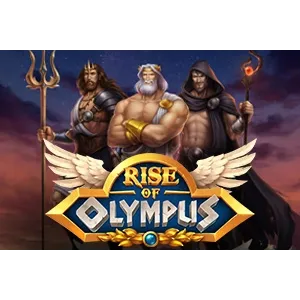
Rise of Olympus documents a 96.50% top RTP, but it is the head of a five-rung ladder down to 84.50% — and across the 19 casinos we track, only one runs the top while 12 run the 94.51% build. Same 5×5 cluster-pays grid, cascades and gods on every version; only the return changes. Here's the split, what the gap costs, and how it plays.

Rise of Olympus RTP is 96.50% at the documented top build, while the lowest documented configuration is 84.50% — a 12.00-point spread. That floor raises the house edge from 3.50% to 15.50%, adding £12.00 of theoretical cost per £100 wagered. Our named 19-casino roster makes the live catch more concrete: one casino runs 96.50%, while 12 run the modal 94.51% version. The game is High volatility, and its maximum win is 5,000× stake. Every build keeps the same 5×5 cluster-pays grid, cascades, Hand of God modifiers and grid-clear free spins; only the long-run return changes.
This review covers Play'n GO's 2018 Rise of Olympus — not the 2022 sequel Rise of Olympus 100 and not Pragmatic Play's Gates of Olympus.
Studios can certify one title in several mathematical configurations, and each operator licenses one. The grid, symbol values and feature rules stay visually identical; only the return changes. The Play'n GO Rise of Olympus RTP ladder has five documented rungs:
| Build | RTP | House edge | Casinos in our roster |
|---|---|---|---|
| Documented top | 96.50% | 3.50% | 1 of 19 |
| Second | 94.51% | 5.49% | 12 of 19 |
| Third | 91.49% | 8.51% | 2 of 19 |
| Fourth | 87.50% | 12.50% | 1 of 19 |
| Documented floor | 84.50% | 15.50% | 0 of 19 |
The five documented rungs account for 16 of the 19 tracked casinos; the remaining 3 read 96.32%, a tracking quirk 0.18 points below the documented top, not a sixth documented build.
The 96.50% ceiling is the documented figure and appears at one tracked casino. The 94.51% second rung has the strongest deployment evidence: 12 named casinos use it, making it the clear modal configuration rather than a marginal lower option. The 91.49% and 87.50% builds are also live, at two casinos and one respectively. The 84.50% floor completes the researched ladder, but the complete named roster records no deployment on it — a paper floor for now.
The ladder is steep. Moving from 96.50% to 94.51% adds 1.99 points to expected loss; moving from top to floor adds 12.00. The first move down nearly doubles the house edge, from 3.50% to 5.49%; at 91.49% it is £8.51 per £100, at 87.50% £12.50, and at the floor £15.50. Those changes are far larger than the few hundredths of a point that usually separate two slots' headline returns, which is why the selected build outweighs the branding comparison. The artwork, 25-cell grid, cascades and three-god feature choice do not reveal it.
The practical check is inside the loaded real-money game: open the information or paytable panel and read its displayed RTP before staking. That active-client figure is the deployment check least vulnerable to an operator change.
A spread only means something once it is money. See how much more the reduced build takes, for your chosen number of spins and bet amount.
The value shown reflects the theoretical variance in expected returns when comparing the highest RTP setting to the lowest RTP setting for the chosen number of spins. This is an illustrative calculation only. It does not predict or guarantee actual results, and outcomes may differ from the theoretical RTP. All values refer to your game balance.
Of every £5,000 you wager, here's where it goes on each build.
Each bar is the full amount wagered: green stays with you, grey is the house's cut you'd pay on either build, and red is the extra the reduced build takes.
At 96.50%, theoretical cost equals 3.50% of turnover. At 84.50%, it equals 15.50%. The 12.00-point gap therefore adds £12.00 for every £100 wagered, whatever stake produces that turnover.
| Stake | Spins | Total wagered | Cost at 96.50% | Cost at 84.50% | Difference |
|---|---|---|---|---|---|
| £0.20 | 500 | £100 | £3.50 | £15.50 | £12.00 |
| £0.20 | 2,000 | £400 | £14.00 | £62.00 | £48.00 |
| £0.20 | 5,000 | £1,000 | £35.00 | £155.00 | £120.00 |
| £1.00 | 500 | £500 | £17.50 | £77.50 | £60.00 |
| £1.00 | 2,000 | £2,000 | £70.00 | £310.00 | £240.00 |
| £1.00 | 5,000 | £5,000 | £175.00 | £775.00 | £600.00 |
| £2.00 | 500 | £1,000 | £35.00 | £155.00 | £120.00 |
| £2.00 | 2,000 | £4,000 | £140.00 | £620.00 | £480.00 |
| £2.00 | 5,000 | £10,000 | £350.00 | £1,550.00 | £1,200.00 |
A 500-spin session at £1 turns over £500. Its long-run expected cost is £17.50 at the documented top and £77.50 at the documented floor, a £60.00 difference on the same game. Two such sessions per week create £52,000 of annual turnover; the full 12.00-point gap then becomes £6,240 in additional theoretical cost.
The more realistic live comparison is 96.50% against the modal 94.51%. That 1.99-point difference costs £1.99 more per £100, £9.95 across 500 £1 spins, or £1,034.80 across the same £52,000 annual turnover. These figures are long-run averages across all possible results, not predictions for one session or estimates of how long a balance will last. Cascades do not add wagers, so turnover stays stake × paid spins; raising the stake merely reaches the same turnover with fewer spins and exposes more cash to each volatile result.
Each paid spin fills a five-column by five-row grid. A win needs at least three matching symbols joined vertically or horizontally; diagonal contact alone does not qualify. Winning symbols disappear, the remaining symbols drop into the empty spaces, and new symbols enter from above. Any new cluster pays and clears in the same cascade sequence, which continues until no further cluster forms. There are no fixed line paths and no variable reel-height calculation: the award comes from connected clusters on the 5×5 grid.
Zeus, Poseidon and Hades are the top regular symbols, followed by a mixed-god combination, Harp, Helmet, Trident and Lightning Bolt. Pegasus is the wild. In our own play tracking the game lands a paying cluster on roughly one spin in three — about 31% — while the grid-clear free-spins feature arrives far less often, near one spin in six (about 17%). That shape is typical of a cluster-pays grid: frequent small clears do less work toward the return than the rare feature. The split of RTP between ordinary clusters and free spins is not published, but the 10× top regular-symbol award against a 5,000× game ceiling shows the largest value sits well beyond one base-game cluster.
GB rules prohibit autoplay and require a minimum 2.5-second game cycle. Five hundred paid spins therefore take at least 1,250 seconds — about 21 minutes — before interface time and longer cascade sequences are added. A cascade does not create a new wager, but it can lengthen the paid game cycle and increase the result from that original stake.
Cluster awards are multiples of total stake. The three named gods share the highest regular-symbol schedule; "God combo" means a qualifying mixed cluster of Zeus, Poseidon and Hades.
| Symbol | 3 | 4 | 5 | Role |
|---|---|---|---|---|
| Zeus / Poseidon / Hades | 0.3× | 1× | 10× | Top regular symbols |
| God combo (mixed gods) | 0.2× | 0.5× | 5× | Mixed-god cluster |
| Harp | 0.15× | 0.3× | 3× | Regular |
| Helmet | 0.15× | 0.3× | 3× | Regular |
| Trident | 0.1× | 0.2× | 2× | Regular |
| Lightning Bolt | 0.1× | 0.2× | 2× | Regular |
| Pegasus (Wild) | Substitutes for every regular symbol; own value up to 50× | Wild | ||
Five of any one god pays 10× stake, while the next regular tier tops out at 5× for a mixed-god cluster. Pegasus is materially stronger as an individual symbol at up to 50×, but even that is only one-hundredth of the 5,000× game maximum. The gap shows where the variance is concentrated: complete-grid clears, continuing cascades and the persistent free-spins multiplier must do the heavy work. The sharpest jump in every schedule comes at five symbols — a god rises from 1× at four to 10× at five — which rewards the extra connected symbol far more than the move from three to four.
A small-paying cluster can still be useful within a cascade. Its cash award may be below stake, but removing it opens cells, drops replacements and can help clear the full grid. The value of a cluster is therefore split between its listed payout and what its removal permits next — though that does not re-label a low award as a near-win.
The Rise of Olympus RTP volatility profile is High, per our exact-title research. The structure supports that label: a five-god cluster pays 10×, Pegasus reaches 50×, yet the overall ceiling is 5,000× and free spins can build a multiplier that does not reset. The three free-spin choices let the player choose how sharply that feature distributes its return — eight Zeus spins at low feature volatility, five Poseidon spins at medium, or four Hades spins at high — but the underlying slot remains High volatility on every build.
A session budget around 150–200 base stakes gives the game more room to absorb uneven clusters and reach the grid-clear feature more than once. At £0.20, that range is £30–£40; at £1, it is £150–£200. It is a sizing reference, not a promise of a feature or a protection against losing the full budget. Reducing stake changes cash exposure per result, not the odds or RTP.
TopSlotsRTP's variance model illustrates the distinction. At identical RTP, a £100 balance staking £1 over 500 spins reaches zero around 7% of the time in a low-volatility model and 53% in a high-volatility model. Rise of Olympus belongs to the latter profile. A volatile route to free spins can consume substantial turnover before a strong feature result appears, so every pound faces either the 3.50%, 5.49%, 8.51%, 12.50% or 15.50% house edge selected by the operator.
The feature system uses the same falling-symbol logic as the base game, then layers in random god interventions, charged meters and a complete-grid trigger.
Every winning cluster is removed after it pays. Symbols above the cleared spaces fall, replacements enter, and the new grid is checked again without another stake. This repeats for as long as fresh clusters form. A long chain matters for two reasons: it can combine several awards from one paid spin, and each removal creates another chance to clear all 25 positions. A fully cleared grid is the route into Wrath of Olympus free spins.
After a non-winning spin, one presiding god can intervene at random. Zeus removes two complete symbol sets so replacements can fall into their positions. Poseidon places one or two Pegasus wilds onto the grid. Hades changes every instance of one symbol set into another, which can create a new connected group. Hand of God modifies an otherwise losing result; it is not a paid bonus buy and does not change the selected RTP build.
God-symbol wins charge the Wrath meter according to cluster size: a three-symbol god cluster fills one section, four symbols fill two, and five fill three. Filling the meter triggers the corresponding bonus round and creates another route for the gods to reshape the grid. Wins made only from Harps, Helmets, Tridents or Lightning Bolts do not fill it. Free spins themselves still require every position on the grid to be cleared.
Clearing the entire 5×5 grid opens a three-god choice. Zeus awards eight spins with the lowest feature volatility, Poseidon awards five at medium volatility, and Hades awards four at the highest. During the chosen round, the win multiplier rises and never resets between spins, up to a 20× cap. Filling the Wrath meter inside the feature adds more spins — Hades +4, Poseidon +3 or Zeus +2 — up to a 20-spin total, and clearing the whole grid again during free spins awards a flat 100× stake. The 20× multiplier cap and the 100× grid-clear reward belong to this original game; the sequel's larger figures do not apply here.
There is no bonus buy and no ante in Rise of Olympus. The free-spins choice can be reached only through a complete grid clear during normal play. No higher pre-spin stake can purchase or increase access to it, and the absence of a buy applies across the documented RTP configurations.
The family expanded the original grid-clear concept through separate releases with separate mathematical limits.
| Title | Published top RTP | Max win | Released | How it differs |
|---|---|---|---|---|
| Rise of Olympus | 96.50% | 5,000× | 2018 | Original; multiplier caps at 20× |
| Rise of Olympus 100 | 96.20% | 15,000× | 10 Nov 2022 | Up to 100 free spins; multiplier caps at 100× |
| Rise of Olympus Origins | 96.24% | 20,000× | 25 Jul 2024 | 5×5 cluster; ladder to 84.20% |
| Rise of Olympus Extreme | 96.20% | 50,000× | 4 Sep 2025 | 5×5 cascades; multiplier to 1,000× |
| Rise of Olympus 1000 | 96.24% | 60,000× | 5 Feb 2026 | 6×5 scatter-pays; multiplier to 1,000× |
Every figure above is from our own title-by-title research (Aug 2026). Origins, Extreme and 1000 each run their own five-build RTP ladder (top ~96.20–96.24% down to ~84.20%), so the operator-selected version applies to them exactly as it does to the original.
Rise of Olympus 100 keeps the same starting god choice — Hades gives four spins, Poseidon five and Zeus eight — but can extend to 100 free spins, raises the persistent multiplier ceiling from 20× to 100× and triples the maximum win from 5,000× to 15,000×. Its 96.20% headline is 0.30 points below the original's 96.50% top. The longer bonus ceiling and larger maximum therefore arrive with a slightly lower documented return.
The later releases scaled the ceiling far harder while holding the return near 96%. Origins (2024) lifts the maximum to 20,000×, Extreme (2025) to 50,000× with the cascade multiplier climbing to 1,000×, and the 6×5 scatter-pays 1000 (2026) to 60,000×. Across the family the maximum win therefore runs 5,000× → 15,000× → 20,000× → 50,000× → 60,000×, while the 2018 original stays fixed at 5,000× and a 20× multiplier. Those numbers describe different distributions, not an upgrade applied to the 2018 client; the original's five documented RTP builds and 19-casino deployment split remain specific to this title.
Within this small Play'n GO comparison, published returns sit between 96.20% and 96.51%, all close to the usual 96% midpoint. Rise of Olympus is mechanically closest to Reactoonz because both use cluster-pays grids. Its three-god choice and complete-grid trigger distinguish it, while the five-rung RTP ladder places it alongside the studio's configuration-led titles rather than a single-return release.
| Slot | Published top RTP | Volatility | Max win |
|---|---|---|---|
| Rise of Olympus | 96.50% | High | 5,000× |
| Reactoonz | 96.51% | High | 4,570× |
| Book of Dead | 96.21% | High | 5,000× |
| Rise of Olympus 100 | 96.20% | High | 15,000× |
The original sits 0.01 points below Reactoonz at the top, 0.29 above Book of Dead and 0.30 above its sequel. Its 5,000× maximum matches Book of Dead, exceeds Reactoonz by 430× and is one-third of the sequel's 15,000×. Play'n GO's use of configurable ladders means provider and title alone do not establish the return: the 94.51% modal version reverses every headline advantage in the table, falling 2.00 points below Reactoonz, 1.70 below Book of Dead and 1.69 below the sequel's published figure.
Under UK Gambling Commission RTS 6, a free-play game offered on the same website as its corresponding real-money version must accurately represent the real-money game's likelihood of winning and prize distribution. An operator-hosted demo should therefore match the linked paid game. A demo loaded outside that operator's lobby may instead use a default configuration and cannot establish the casino's live RTP.
Demo mode is useful for learning how orthogonal clusters connect, how cascades refill the grid, what each Hand of God action does and how the Zeus, Poseidon and Hades free-spin choices differ. Before money is used, the real-money client's information panel still needs to be checked. Its displayed figure governs the actual deployment, not a number seen in a separate demo.
High volatility limits the demo as a forecast. A short sample can demonstrate the rules but cannot reproduce a 96.50%, 94.51% or lower long-run return, and it may never clear all 25 positions. Demo results do not make a later paid outcome more or less likely.
This is a match assessment, not a recommendation. The game fits a player using roughly 150–200 base stakes, playing for a cascade-driven grid clear and comfortable with a High-volatility result distribution. At the £0.20 minimum, £30–£40 provides that number of stakes. Choosing Zeus in free spins reduces feature volatility, but it does not turn the underlying game into a low-volatility slot.
It does not fit a player seeking frequent, evenly sized returns, a predictable route to the feature or one fixed RTP across every casino. Regular god clusters peak at 10×, while the 5,000× ceiling depends on much rarer feature conditions. There is no bonus-buy shortcut, and 18 of the 19 tracked deployments sit below the exact 96.50% headline.
The honest test is the response to 200 losing spins. If the response would be to increase the stake, extend a loss limit or chase a full-grid clear, this is the wrong game for that session. A smaller stake creates more attempts within a fixed budget; it does not make a god intervention, cascade or bonus trigger more likely on the next spin.
Slots have no strategy that changes random outcomes. The useful decisions happen before play: checking the selected build, sizing the stake against a fixed budget, and setting a loss limit and time limit. On a High-volatility game, lowering the stake relative to the same balance reduces the cash impact of each swing while leaving the cluster probabilities and RTP unchanged.
GB online-slot stakes are capped at £5 for players aged 25 or older and £2 for players aged 18–24. Applied to the 5,000× maximum, those caps produce arithmetic ceilings of £25,000 at £5 and £10,000 at £2. They are multiplication of the documented cap by the allowed stake, not likely session outcomes.
Checking the active build is the only pre-play choice that changes the underlying long-run maths. Moving from the 94.51% modal deployment to 96.50% removes £1.99 of expected cost per £100 wagered; changing the feature choice does not change the game-level RTP. Limits should be set before the first spin and left fixed. TopSlotsRTP's RTP calculator and cost calculator can translate the displayed return, planned stake and spin count into turnover and theoretical cost.
| Slot | Published top RTP | Lowest documented build | Volatility | Max win |
|---|---|---|---|---|
| Rise of Olympus | 96.50% | 84.50% | High | 5,000× |
| Reactoonz (Play'n GO) | 96.51% | 87.50% | High | 4,570× |
| Gates of Olympus (Pragmatic Play) | 96.50% | 94.50% | High | 5,000× |
| Book of Dead (Play'n GO) | 96.21% | 84.18% | High | 5,000× |
At the documented top, Rise of Olympus is 0.01 points below Reactoonz, level with Gates of Olympus and 0.29 above Book of Dead. All four are High volatility. Reactoonz is the closest mechanical comparison because it is another Play'n GO cluster-pays grid. Gates supplies the direct Olympus-theme comparison from a different studio, using tumbling symbols and multiplier orbs. Book of Dead shows the same provider's use of an RTP ladder and shares the 5,000× maximum.
The roughly 96% industry midpoint makes 96.50% a strong headline, but deployment determines whether that comparison survives. At the common 94.51% build, this game falls 2.00 points below Reactoonz, 1.99 below Gates and 1.70 below Book of Dead. At the 84.50% documented floor, the deficits become 12.01, 12.00 and 11.71 points respectively.
The wide ladder, not the headline, is the real point of difference. Book of Dead runs a comparably steep ladder down to 84.18% — marginally below this game's 84.50% floor — while Reactoonz bottoms at 87.50% and the Olympus-themed Gates of Olympus barely moves from its top, at 94.50%. Rise of Olympus and Book of Dead are therefore the two deepest Play'n GO ladders in this set, both reaching the mid-80s. For Rise of Olympus, both the wide documented range and the named live split are known: the top exists, the floor is absent from the current roster, and 94.51% is the return most commonly encountered.
The exact-title studio page, dated 22 August 2018, confirmed Play'n GO, the 5×5 cluster layout, cascades and release. Our exact-title research supplied the five documented configurations, High volatility, £0.20–100 stake range, symbol awards and full feature rules. The deployment snapshot was checked on 21 August 2026 against a named roster of 19 casinos; every count in the versions table can be reconciled to those operator rows. Series entries and Reactoonz, Gates of Olympus and Book of Dead were checked title by title. Our research and operator pages give a 5,000× maximum, the figure used here; a 2,500× reading also circulates, and the current public studio page does not display a total maximum, so the GB cash-cap figures are conditional on 5,000×.
No session-play claims are used. The studio does not publish the split between base-game and feature RTP. Operators can switch documented configurations without announcement, so the roster is a dated snapshot and the loaded real-money client remains the final check.
A realistic short session can contain many low or losing results without reaching the complete-grid feature. TopSlotsRTP's model places the chance of a £100 balance reaching zero over 500 £1 spins around 53% for a high-volatility model, compared with 7% for a low-volatility model at the same RTP. This illustrates variance; it does not forecast this game's next 500 results.
RTP is a long-run average, volatility governs short-term dispersion, and no outcome is ever due. The cost table measures theoretical loss across turnover, not how long a bankroll will last. Limits hold when set before play and kept fixed. If gambling stops feeling like a choice, the National Gambling Helpline is available on 0808 8020 133, BeGambleAware provides information, and GamCare provides confidential support.
Written by Tony Sartori, Game Reviewer · Reviewed by Mark Gruetze · Last updated Aug 2026
More Play'n GO slots we've checked — each showing the best live RTP we've found and the casino running it. Always confirm the figure in the game's own paytable before you play.
▶ Play Demo ▶ Play Demo
 ▶ Play Demo
 ▶ Play Demo
 ▶ Play Demo
 ▶ Play Demo
 ▶ Play Demo
 ▶ Play Demo
 ▶ Play Demo
 ▶ Play Demo
 ▶ Play Demo